Showing posts with label Historical. Show all posts

July 01, 2013

Between Shades of Gray - Ruta Sepetys

No comments:

Title: Between Shades of Gray
Author: Ruta Sepetys
Publisher: Penguin Books
Release date: 2011
Pages: 344
 

* I shut the bathroom door and caught sight of my face in the mirror. I had no idea how quickly it was to change, to fade. If I had, I would have stared at my reflection, memorizing it. It was the last time I would look into a real mirror for more than a decade. *
_________________________________ 

Lina is just an ordinary, youg Lithuanian girl. She paints, she draws, she gets crushes on boys. Until the night in 1941 when Soviet guards haul Lina and her family from their home. Separated from her father and forced into a cattle car, Lina, her mother and her young brother begin a harrowing journey north, across the Arctic Circle, to a work camp in the frozen wastes of Siberia.
There they are forced, under Stalin's orders, to struggle for their lives under the cruellest of conditions. Lina's only solace is her art. At great risk, she draws, recording the beauty and the horror and even the ordinariness that she sees every day, hoping that one day her father, wherever he may be, might look upon her work.
Until that day Lina must wait, draw and try to survive...

___________________________ 

* Exactly a year before, the Soviets have begun moving troops over the borders into the country. Then, in August, Lithuania was officially annexed into the Soviet Union. When I complained at the dinner table, Papa yelled at me and told me to never, ever say anything derogatory about the Soviets. He sent me to my room. I didn’t say anything out loud after that. But I thought about it a lot. *


Given the reaction of most people I talked to about this book, I would like to clarify something before I start. This review is not going to be about an erotic novel. It is not going to be about Anastasia and Christian’s relationship. It is not going to be about El James’ Fifty shades of grey. No, Between shades of gray has got nothing to do with the fast-selling novel everybody seems to be talking about, it is a completely different book, although there are similarities in the titles.
The story is that of Lina, a young Lithuanian girl who is deported one night in 1941 with her mother and brother. Her father has been arrested as well, but she does not know where he is. A horrible journey starts for them and for many other Lithuanians, from cattle cars to labour camps. Lina must fight to survive every day in these harsh conditions, with no food and constant fear of the NKVD police. But she wants to see her home again, and her father. So despite the risk, she draws and writes, hoping her art will save them.
The theme chosen by Ruta Sepetys is grim: deportation. Too often, we forget that other countries than Western European ones have been affected by war in a dramatic way. It is the case of Lithuania, torn between Russia and Germany. The war was the opportunity for the secret police working under Stalin'orders to remove anybody considered as dangerous for their government. So in a few days only, thousands of people were deported and nobody reacted. The horror began for many Lithuanians, Estonians, Latvians and Finns, whose families were torn apart, who were sent to prison or to labour camps, killed…
In this historical background, we get to know Lina and her family. Lina is only fifteen and is like any girl of her age… until she is dragged by the secret police and sent to Siberia. What did she do to deserve such inhuman treatment? Like many others, nothing, but she is considered to be a threat for the government and so she need to disappear.
The scenes describing the behaviour of the secret police and the horrors lived by the prisoners are rather violent. Full of details, nothing is hidden or weakened. More than once, I could actually feel the characters’ fear in front of the guards. However, in my opinion, Between shades of gray is a message of hope and love and not only a dark novel about the horrors of deportation.
Lina is a moving character and I grew attached to her in the first few pages already. I liked the fact that she is an ordinary girl, apart from her gift for drawing. However, we will quickly understand that she is also extremely strong and that only by remaining herself she can hope to survive. The other characters are also well portrayed, particularly her brother and mother but also the people forced to share the cattle car with them and later on work on the labour camp.
Although it is fiction, we can see that Ruta Sepetys did a great job of research about Lithuania, Siberia, labour camps and deportation. The feelings described are extremely moving and seemed very realistic to me. How can we not be moved by such horrors? And how can we not admire the courage showed by these people? I tried to imagine how I would react if I were in their situation but try as I might, I couldn’t. What is amazing is the ways they find to survive, to keep a glimmer of hope and try and be happy. Of course, they cannot find happiness in this case, but their memories and the way they help each other is extraordinary.
Mixed with the main story, we have various flashbacks which I particularly enjoy for two reasons. First of all, they show a great contrast between how Lithuania was and the present of the story. We see Lina’s happy childhood, her teenager’s concerns and her dreams. And we understand how, in one night, everything can change. The second reason is connected to the point of view in which the story is told. Lina is giving an account of what happens and as she is a young girl, she does not understand everything about politics. Also, there are secrets kept from her in order to protect her. The flashbacks are useful because they enable us to discover the situation little by little, at the same time as Lina.
The writing style also matches the point of view: it is simple, without too many details, just like a teenager’s diary. Yet, it is extremely agreeable to read and you will not even notice as you go through the pages. Drawn by Lina’s desire to live and by her dreams, you will discover how the story unfolds for her and her family. But is there really an end to such horrors?
Between shades of gray is a novel full of emotion. Although it is fiction, it gives us a good insight into the situation of Lithuania during WWII and into deportation. The characters are full of personality and their kindness can only be admired. They dream, they fight, they hope for their life to become normal again. But is it possible after such horrors? And is it possible to survive in such hostile environment? This book made me realise more than ever before how lucky I was to be born in a safe country and era.


Surviving with wolves - Misha Defonseca

No comments:

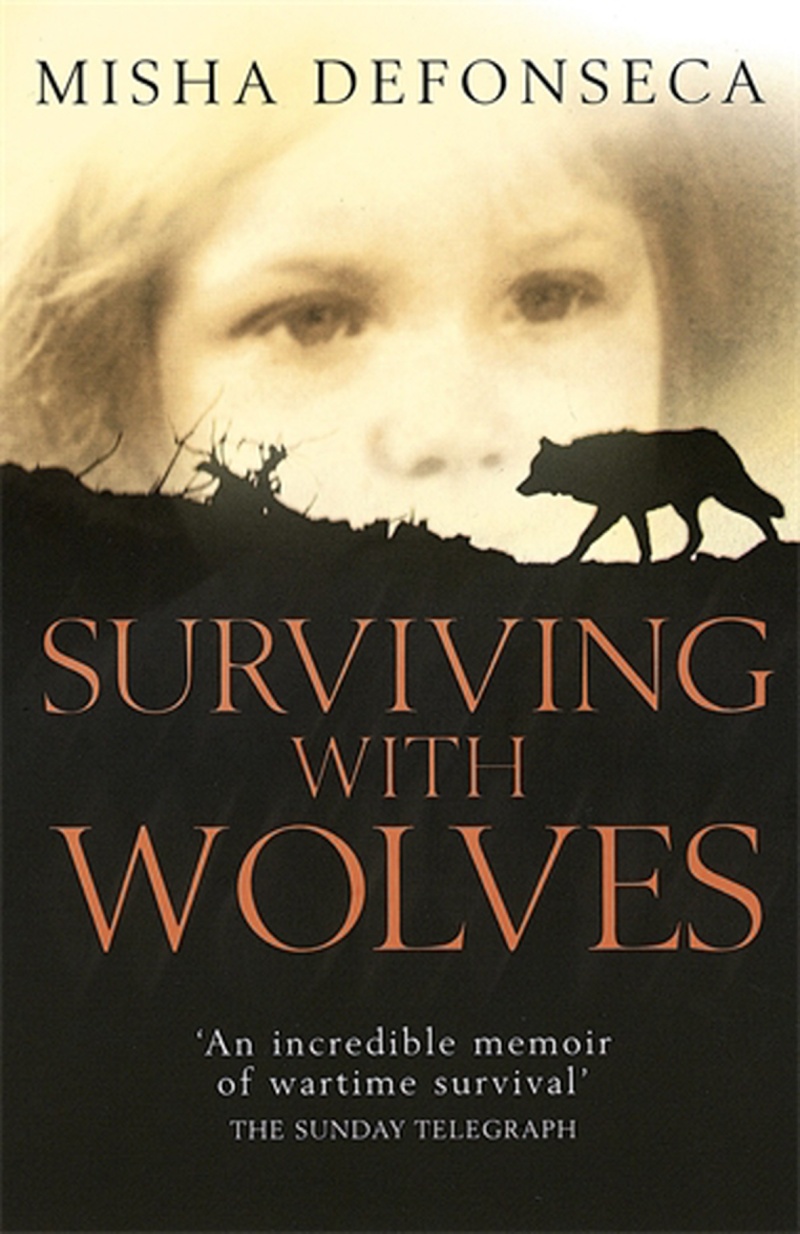
Title: Surviving with Wolves
Original Title: Survivre avec les loups (French)
Translator: Sue Rose
Author: Anita Shreve
Publisher: Piaktus books
Release date: 1997 (English transalation: 2005)
Pages: 231
 

* You keep going first to find something to eat and then because you always believe that, beyond that tree or over that high slope, you'll find a village, or people or a road sign pointing you in the right direction.*
_________________________________ 

Misha was only seven when the Nazis took her Jewish parents away from her in Brussels. No one told her why her parents were no longer with her; only that they had gone East. So one day, equipped with just a tiny compass, the little firl set out East to find them. Alone and on foot, Misha crossed Belgium, Germany, Poland and the Ukraine.
Surviving with wolves is Misha's extraordinary and poignant story - of how a young girl witnessed the appalling cruelties of war, and for whom the animals of the forest proved safer than humans. It is a book that will never be forgotten by anyone who reads it.


“At one lecture, a woman said to me, ‘You’re not a holocaust survivor. You didn’t live in the camps.’ Hers was just one voice among others. It shouldn’t have upset me as it did, but I was annoyed with myself for telling the world a story that wasn’t universally accepted, just because it wasn’t like everyone else’s. I was different, as always… ” Surviving with wolves is indeed unique, a story different from any other one you might have read. It takes place during the war and the reader sees through Jewish eyes. Until then, you will tell me that there is nothing unusual about it, and you are right. What makes this book so extraordinary how its story actually unfolds and how the different events that occur are told.
Misha lives in Brussels with her parents and even though they are rather poor, she is happy. But she is Jewish and her life changes forever when her parents are taken away by Nazis. Misha is saved and placed in a Belgian family who will take care of her. As she is only seven, she does not fully understand what is happening. She knows that she must not say that she is Jewish; she knows that the Nazis are dangerous; she knows that her parents are in the East. Nobody explained anything else to her. So one day, she sets off towards the East to find them and starts an unimaginable journey through Europe in war.
The story of the journey itself is wonderful. We follow the little girl who knows nothing about war in her adventure. She is innocent but clever and very brave. From the very beginning, we see how she can survive in hostile environment, with people fighting around her and the whole world collapsing. Because of this traumatic period, nobody tries to stop her; it is not usual to see poor and filthy children on their own, and Misha does not trust people. She steals food from the farms or eats from carcasses rather than begging or asking for help. She sleeps in the forest rather that hideing in deserted buildings. This is how, on her long way trough Belgium, Germany, Poland, Russia and the Ukraine, she meets wolves with whom she develops a wonderful relationship.
This relationship is incredible at first, but yet as the story goes on we understand it better. The descriptions of the majestic animals are poignant and we clearly see why the little girl trusts them rather than humans: they don’t have guns, they are not deliberately cruel to one another, they have clear rules and they can be trusted… Unlike human beings or at least unlike the human beings Misha has met.
The scenes with nature are cleverly mixed with war scenes. As Misha does not trust humans, she does not seek social contact but inevitably she will see some of the horrors of the war. An interesting aspect is that, by travelling, we see how different people react to the war. The reader is given an insight into Polish guerrillas’ fights, Jews’ persecution, German soldiers’ methods, Russian civilians’ hope and prisoner camps…
These are described with accurate details of what the little girl felt when she actually lived the scene and mixed with explanations given by Misha years later, when she writes about her adventure. Telling this story with two perspectives was a sensible choice: we understand the little girl experience, her innocence and how traumatic everything was for someone who did not understand at all the gravity of what was happening; at the same time, we have more factual explanation to help us understand how Misha’s personal story is linked to the rest of the events.
One of the main controversies that arose with the publication of this book regarded the truth of the story. Even if Misha first presented it as real, it turned out that she had actually made it up: she was not Jewish and she did not travel all the way through Europe, living with wolves, to find her parents. This revelation should however not lessen the beauty of the story. Misha has survived the war and her need to tell a story that differs from the one she actually lived shows how she tries to heal from this traumatic experience.
Surviving with wolves is therefore a book that is worth reading, especially for people who like animals and are interested in war stories. However, anybody can find it interesting, as it is extremely varied and well written..

 
The pilot's wife has been adapted into a film. 


War Horse - Michael Morpurgo

No comments:

Title: War Horse
Author: Michael Morpurgo
Publisher: Egmont
Release date: 1982
Pages: 288
 

*Some in the village, only a very few now and fewer as each year goes by, remember Joey as he was. His story is written so that neither he nor those who knew him, nor the way they lived and died in, will be forgotten.*
_________________________________ 

'I saw the grey soldiers ahead of us raise their rifles and heard the death rattle of a machine gun...' A powerful story if the truest of friendships in the worst of wars from the award-winning master storytelle Michael Morpurgo.


Love, friendship and courage... These three words describe perfectly War horse, the moving story of the horse Joey and his companion Albert through the Great War.
Michael Morpurgo takes the reader to the English countryside, where young colt Joey is sold to a farmer. The farmer's son Albert finds in love with the horse straightaway and as time goes by, their relationship evolves into a true friendship. Although Joey is not a farm horse he successfully learns how to pull a cart and plough to earn his keep and spends all the rest of his time with Albert.
However as war is declared, their destiny is about to change forever. Joey is sold to the army and has to go to the front while Albert, too young to join in as a soldier, stays on the farm. Before they part, he promises his horse that they will meet again.
The story goes on, describing the horror of a war where humans and animals are used like machines and do not understand what they are fighting for anymore. We discover the front line, the battles, the cavalry, the trenches and the artillery troops. Michael Morpurgo portrays extremely realistic scenes of the war which are ideal give children a basic knowledge of History. There is just the right level of violence to make them understand the horror and consequences of the war on people and animals.
We rapidly grow attached to that extraordinary brave horse. Joey, who is as you will have understood, the narrator and main character of the story, goes from farm horse to cavalry horse, war prisoner, ambulance horse and artillery horse. During his fight for survival he meets various people who will change his life and we discover little by little the lives of each one of them as well as the consequences the war had on them. Captain Nicholls, Emily and her grandfather, old Friedrich… so many people who fall for that heroic horse who brings a little light in their cold and dark daily life. But Joey will never forget his first and dearest friend Albert.
Michael Morpurgo skilfully mixes scenes of friendship and love with moments of fear and horror. This moving story is perfect for children who like animals and gives a good overview of the implications of World War I. Older reader might enjoy the adventure as well, especially if they want to know more about how horses were used during that war.
_________________________________


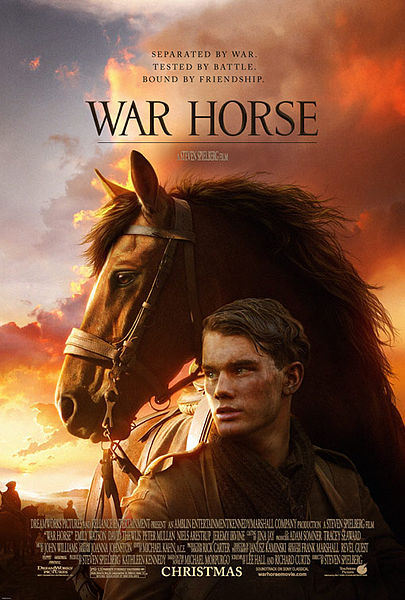
War Horse has been adapted into a film. 
See my film review and comparison with the book here.


Design by Laraemilie